Calculating Enrichment ROI: A Complete Framework
Measure the true ROI of data enrichment investments. Learn the metrics, formulas, and frameworks to justify and optimize enrichment spend.
Data enrichment tools aren’t cheap. ZoomInfo can cost $60K+ annually. Clay credits add up quickly. Even Breeze Intelligence has real costs.
How do you know if it’s worth it? This guide provides a framework for calculating enrichment ROI—and more importantly, optimizing it.
The ROI Formula
At its simplest:
ROI = (Value Generated - Cost) / Cost × 100

Example:
Value Generated: $500,000 in pipeline influenced
Cost: $50,000 (tools + credits + time)
ROI: ($500,000 - $50,000) / $50,000 × 100 = 900%
But “value generated” is where things get nuanced.
Measuring Value
Direct Value: Pipeline Attribution
Track deals influenced by enriched data:
Attribution Model:

1. Tag enriched records
   - Source: "Enriched via [Tool]"
   - Date: "Enrichment Date"

2. Track through funnel
   - Enriched Leads → MQLs → SQLs → Opportunities → Closed Won

3. Calculate influence
   - Total Closed Won from enriched records
   - Compare to non-enriched conversion rates
Salesforce Report:
Report: Enrichment-Attributed Revenue

Filters:
- Opportunity Stage = Closed Won
- Close Date = This Year
- Contact.Enrichment_Source__c is not blank

Columns:
- Opportunity Amount
- Contact.Enrichment_Source__c
- Contact.Enrichment_Date__c

Summary:
- SUM(Amount) by Enrichment_Source__c
Indirect Value: Efficiency Gains
Enrichment saves time. Time has value.
Time Savings Calculation:

Research Time Before Enrichment:
- Average time researching a prospect: 15 minutes
- Prospects researched per rep per day: 20
- Daily research time: 300 minutes (5 hours)

Research Time After Enrichment:
- Average time researching a prospect: 3 minutes
- Prospects researched per rep per day: 20
- Daily research time: 60 minutes (1 hour)

Time Saved:
- Per rep per day: 4 hours
- Per rep per month: 80 hours
- Per rep per year: 960 hours

Value of Time:
- Fully-loaded rep cost: $150,000/year
- Hourly rate: $75/hour
- Annual value per rep: 960 × $75 = $72,000

For a 10-rep team:
- Annual time value: $720,000
Indirect Value: Quality Improvements
Better data → better outcomes:
Quality Impact Metrics:

Email Deliverability:
- Before enrichment: 85%
- After enrichment: 97%
- Improvement: +12%
- Value: More emails reaching prospects

Contact Rate (Phones):
- Before enrichment: 25% connect rate
- After enrichment: 42% connect rate
- Improvement: +17%
- Value: More conversations

Lead Score Accuracy:
- Before: 60% of "hot" leads actually qualified
- After: 85% of "hot" leads actually qualified
- Value: Less time on unqualified leads
Cost Components
Tool Costs
Example Annual Stack:

ZoomInfo (primary database): $60,000
Clay (waterfall + workflows): $12,000
NeverBounce (email verification): $3,000
Cognism (EU + phones): $24,000
─────────────────────────────────
Total Tool Cost: $99,000
Credit/Usage Costs
Variable Costs:

Clay credits used: 50,000/month
Cost per credit: $0.05
Monthly variable: $2,500
Annual variable: $30,000

Enrichment volume: 10,000 records/month
Cost per enrichment: $0.25
Implementation Costs
One-Time Costs:

Implementation time: 80 hours
Internal hourly rate: $100
Implementation cost: $8,000

Integration development: $15,000
Training: $5,000
─────────────────────────────────
Total One-Time: $28,000

Amortized over 3 years: $9,333/year
Operational Costs
Ongoing Costs:

Admin time: 5 hours/month
Hourly rate: $75
Monthly ops cost: $375
Annual ops cost: $4,500
Total Cost of Ownership
Year 1 TCO:

Tools: $99,000
Variable (credits): $30,000
Implementation: $28,000
Operations: $4,500
─────────────────────────────────
Total Year 1: $161,500

Year 2+ TCO:

Tools: $99,000
Variable: $30,000
Operations: $4,500
─────────────────────────────────
Total Year 2+: $133,500
ROI Calculation Framework
Step 1: Establish Baseline
Before implementing enrichment, measure:
Baseline Metrics:

Lead Volume:
- Leads created/month: 2,000
- Leads with complete data: 600 (30%)
- Leads with email: 1,800 (90%)
- Leads with phone: 800 (40%)

Conversion Rates:
- Lead → MQL: 15%
- MQL → SQL: 30%
- SQL → Opportunity: 40%
- Opportunity → Closed Won: 20%

Overall: Lead → Closed Won: 0.36%

Sales Efficiency:
- Research time per prospect: 15 min
- Connect rate (phone): 25%
- Email deliverability: 85%
Step 2: Measure Post-Implementation
After enrichment is running:
Post-Enrichment Metrics:

Lead Quality:
- Leads with complete data: 1,600 (80%) ← +50%
- Leads with email: 1,900 (95%) ← +5%
- Leads with phone: 1,400 (70%) ← +30%

Conversion Rates:
- Lead → MQL: 22% ← +7%
- MQL → SQL: 35% ← +5%
- SQL → Opportunity: 45% ← +5%
- Opportunity → Closed Won: 22% ← +2%

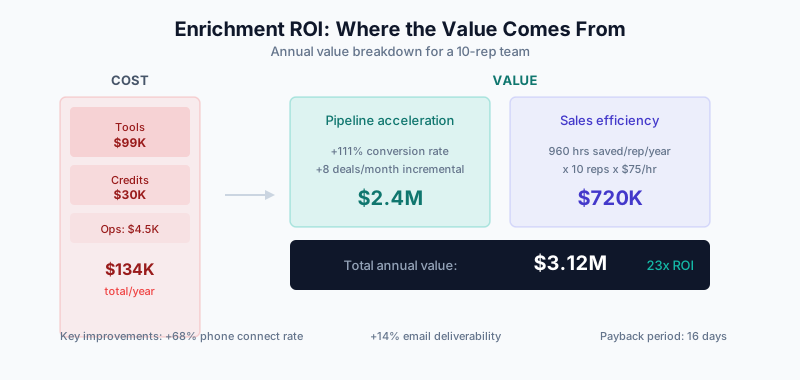
Overall: Lead → Closed Won: 0.76% ← +111%

Sales Efficiency:
- Research time per prospect: 3 min ← -80%
- Connect rate (phone): 42% ← +68%
- Email deliverability: 97% ← +14%
Step 3: Calculate Value
Pipeline Value Calculation:

Monthly Leads: 2,000
Pre-enrichment conversion: 0.36%
Post-enrichment conversion: 0.76%

Pre: 2,000 × 0.36% = 7.2 deals/month
Post: 2,000 × 0.76% = 15.2 deals/month
Lift: +8 deals/month

Average Deal Size: $25,000
Monthly Value: 8 × $25,000 = $200,000
Annual Value: $2,400,000
Efficiency Value Calculation:
Sales team size: 10 reps
Time saved per rep per year: 960 hours
Hourly value: $75
Annual efficiency value: 10 × 960 × $75 = $720,000Total Annual Value:
Pipeline value: $2,400,000
Efficiency value: $720,000
─────────────────────────────────
Total: $3,120,000Step 4: Calculate ROI
Year 1 ROI:

Value: $3,120,000
Cost: $161,500

ROI = ($3,120,000 - $161,500) / $161,500 × 100
ROI = 1,832%

Year 2+ ROI:

Value: $3,120,000
Cost: $133,500

ROI = ($3,120,000 - $133,500) / $133,500 × 100
ROI = 2,237%
Optimization Strategies
Strategy 1: Optimize Coverage
Not all records need full enrichment:
Segmented Enrichment:

Tier 1: Enterprise leads (>500 employees)
- Full waterfall enrichment
- All providers
- Cost: $0.50/record

Tier 2: Mid-market leads (50-500 employees)
- Standard enrichment
- Top 2 providers
- Cost: $0.20/record

Tier 3: SMB leads (<50 employees)
- Basic enrichment
- Primary provider only
- Cost: $0.05/record

Result:
- Same coverage
- 40% cost reduction
- Better ROI
Strategy 2: Reduce Waste
Don’t enrich records you don’t need:
Pre-Enrichment Filters:

Skip enrichment if:
- Personal email domain (gmail, yahoo, etc.)
- Known competitor
- Known customer (already in CRM)
- Outside target geography
- Below revenue threshold

Example:
- 2,000 leads created
- 400 filtered out (20%)
- 1,600 enriched
- Cost reduction: 20%
Strategy 3: Optimize Provider Mix
Waterfall enrichment should be ordered by cost-effectiveness:
Provider Optimization:

Test coverage rates:
- Provider A: 65% coverage, $0.10/credit
- Provider B: 55% coverage, $0.08/credit
- Provider C: 45% coverage, $0.15/credit

Cost per successful enrichment:
- Provider A: $0.10 / 65% = $0.154
- Provider B: $0.08 / 55% = $0.145 ← Best
- Provider C: $0.15 / 45% = $0.333

Optimal order: B → A → C
Strategy 4: Cache Aggressively
Don’t pay for the same data twice:
Caching Strategy:

Contact-level cache:
- Cache enriched data for 30 days
- Same person re-enters → use cache
- Savings: 15-20% of enrichment volume

Company-level cache:
- Cache company data for 90 days
- New contact at same company → use cache
- Savings: 10-15% of enrichment volume

Total savings: 25-35%
ROI by Use Case
Outbound Prospecting
Use Case: Cold outbound campaigns

Investment:
- ZoomInfo: $60,000/year
- Clay: $12,000/year
- Email verification: $3,000/year
Total: $75,000/year

Return:
- Outbound meetings booked/month: 100
- Meeting → Opportunity: 40%
- Opportunity → Closed Won: 25%
- Deals/month: 10
- Average deal: $30,000
- Annual revenue: $3,600,000

ROI: 4,700%
Inbound Lead Enhancement
Use Case: Enrich form submissions

Investment:
- Breeze Intelligence: $6,000/year
- Clay (gaps): $6,000/year
Total: $12,000/year

Return:
- Conversion rate improvement: +50%
- Additional deals/year: 24
- Average deal: $20,000
- Additional revenue: $480,000

ROI: 3,900%
Account-Based Marketing
Use Case: Target account research

Investment:
- ZoomInfo (accounts + contacts): $60,000/year
- Clay (research automation): $15,000/year
- Bombora (intent): $24,000/year
Total: $99,000/year

Return:
- Target accounts engaged: 500
- Account → Opportunity: 15%
- Opportunities: 75
- Opportunity → Closed Won: 30%
- Deals: 22
- Average deal (enterprise): $100,000
- Annual revenue: $2,200,000

ROI: 2,122%
Presenting ROI to Leadership
Executive Summary Format
Data Enrichment ROI Summary

Investment: $133,500/year

Returns:
├── Pipeline Acceleration: +$2,400,000
├── Sales Efficiency: +$720,000
└── Total Value: $3,120,000

ROI: 2,237%
Payback Period: 16 days

Key Improvements:
• +111% conversion rate
• +80% research time saved
• +68% phone connect rate
• +14% email deliverability
Dashboard Metrics
Build a live dashboard showing:
Real-Time Enrichment ROI

This Month:
├── Records Enriched: 5,234
├── Enrichment Spend: $2,617
├── Deals from Enriched Leads: 8
├── Revenue from Enriched Leads: $187,000
└── Monthly ROI: 7,047%

Trailing 12 Months:
├── Total Enrichment Spend: $133,500
├── Revenue Attributed: $2,847,000
└── Annual ROI: 2,033%

Trends:
├── Cost per enrichment: ↓ 12% (optimization)
├── Coverage rate: ↑ 8% (provider additions)
└── Conversion rate: ↑ 3% (quality improvements)
Common ROI Mistakes
Mistake 1: Ignoring Indirect Value
Wrong:
"We spent $100K and only closed $150K in attributable deals."
ROI: 50%

Right:
"We spent $100K, closed $150K in attributable deals,
saved $300K in rep time, and improved conversion by 50%
across all leads (not just directly attributed)."
True ROI: Much higher
Mistake 2: Wrong Attribution Window
Wrong:
Measuring only same-month conversion

Right:
B2B sales cycles are 3-12 months
Use 12-month attribution window
Include influenced pipeline, not just created
Mistake 3: Not Accounting for Baseline
Wrong:
"We got 100 deals this year with enrichment."
(But would have gotten 60 without it)
True impact: 40 incremental deals

Right:
Compare to baseline period
Control for other variables
Measure true lift
Related Guides
- Salesforce Data Quality Scorecard — Track quality metrics
- Waterfall Enrichment — Optimize enrichment costs
- The B2B Data Decay Problem — Why enrichment is necessary
- Modern Outbound Data Stack — Full stack architecture
- ZoomInfo Implementation Guide — Enterprise enrichment
- Clay 101 — Cost-effective enrichment platform